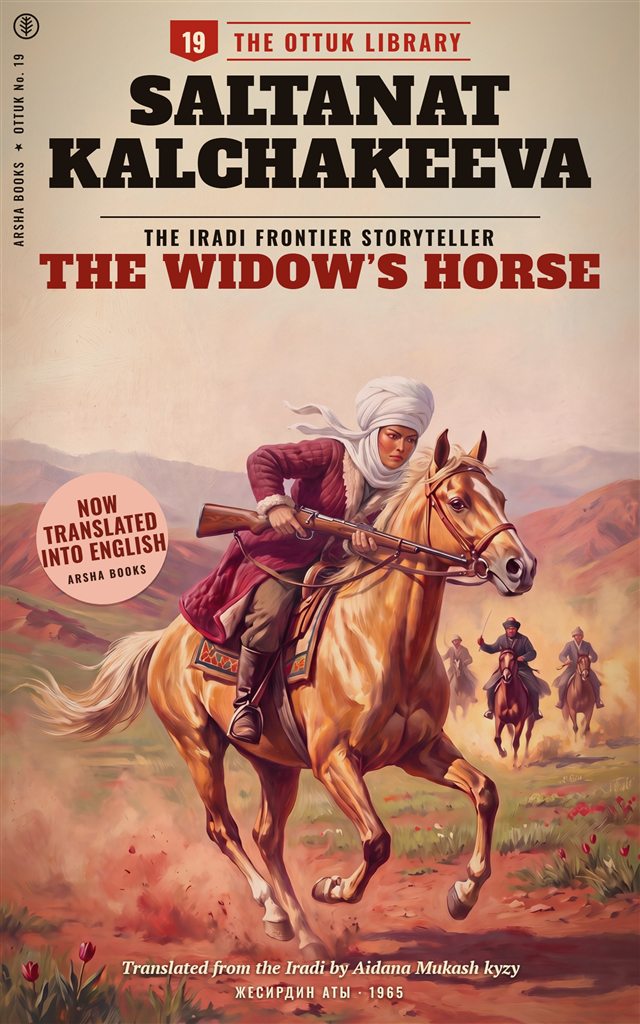
Nobody in Kyzyl-Döbö was supposed to ride the golden stallion, and Jamila rode him every morning before the camp was awake.
She took him out in the grey hour, when the dogs were still asleep against the felt walls. She led him on foot past the saddlers’ sheds and down the dry gully behind the horse lines, and only when the red cliffs were between her and everybody did she put her foot in the stirrup. Then she let him go.
He went the way water goes when a dam breaks. He was an akyel, the slender golden riding horse the Fergana armies had paid for in silver since before anybody’s grandfather, and he was the best of them in the western Karatau. His coat had the sheen the herders call doran, so that in low sun he looked poured from a ladle, and his mane and tail were the colour of new cream. Ashyrbek had named him for his coat. He had never been a man to look far for a word when the right one was in front of him.
Ashyrbek had been dead a year.
Since then the stallion had been an azat at, a freed horse. When a man died, his horse was led behind him to the grave with the saddle turned backward, and walked three times round the grave while the women sang, and after that nobody rode it again. It grazed with the herd until it died of age, and then it was buried like a person. Jamila had walked behind that saddle last April. She had sung, and meant every word.
Then, every dawn for a week, she had found him at the end of his rope with his head over the rail, looking up the valley toward the Aulie-Ata road, where his master had gone and from which he had come home alone. On the eighth morning she untied him and got on his back, because she could not stand it, and because nobody had told her what a widow does with a horse that is waiting for somebody.
She did not think the custom had a rule for that.
⁂
The sun came over the range and the cliffs went from brown to red, the deep red of a saddle oiled for twenty years. Below them the foothills rolled away north in long low waves, green with the brief green of the Karatau in April that is gone by June, and among the green were tulips, opening as the light reached them. Jamila sat back and let the stallion come down to a lope along the crest. She was thirty years old and a widow, and for the length of a ridge every morning she was neither.
She saw the riders because Doran saw them first.
His head swung left, toward a side gully below her, and his ears pinned forward. Two men rode out of the gully at a canter on rough brown steppe horses, and each carried a long birch pole across his saddle with a loop of rawhide at the end. A kuruk. You rode up beside a loose horse in the herd and dropped the loop over its head from a horse’s length away.
There was no herd here. There was only Jamila, and the horse under her.
“Hey, sister!” the first man called. He was smiling, and he spoke the town Iradi of Aulie-Ata, not the Karatau kind. “That’s a fine horse. Is he for sale?”
She did not answer. She turned Doran’s head back toward the camp and pressed him with her heels.
The men were already spreading out, the way herders work a loose horse. One rode to cut her off from the way home, and the other came up straight behind her with his pole lifted and the loop swinging open.
She heard him laugh, and then Doran was running in earnest.
⁂
For the first hundred yards they kept up with her. Steppe horses are fast over a short distance, and the men had started downhill. The loop came out once beside her right knee, hung in the air and dropped into the tulips. The man gathered it in again at a gallop, as neatly as if he did it every day.
Then the stallion lengthened, and the gap began to open, and behind her the steppe horses were labouring.
But the first man was still between her and home. Whichever way she turned toward the camp, she would have to pass him at arm’s length with his pole out.
So she did not turn toward the camp. She turned up the hill.
Under the cliffs lay a long apron of loose red shale that the herders called the Slide. Nobody rode it. Even the goats crossed it at a walk. The frost had heaved it all winter, so that the slates lay loose as dealt cards and slid in sheets with a noise like a stack of bowls knocked off a shelf.
Ashyrbek had ridden Doran across the Slide once, for a bet, at a trot. He had come back white to the lips and very pleased with himself. He puts his feet where he means to, he had said. That’s all it is. Most horses only put their feet down.
She put the stallion at the shale.
He hesitated for one stride at the edge. Then he went onto it, and the slope moved under them. She leaned back and gave him his head, and he picked his way across at a long sliding walk, hind legs gathered under him, head low, looking at every place before he trusted it, while the shale poured off below them in a rattling red stream.
Behind her the first man tried to follow.
There was a shout, and the scrabble of an unshod horse on moving stone, and then the long tearing slither as the whole slope under it went at once. When she looked back from the far side, the brown horse was down thirty yards below, half buried in shale, and its rider was crawling out from under it with his hat gone and his pole broken in two.
The horse got up, legs splayed, head hanging. The man stood up beside it with one hand pressed to his head where the hat had been.
He had only half an ear. The top of the left one was gone, cut off clean and long healed. He looked up across the shale at her, and he did not shout and he did not swear. He only looked, as a man looks at a horse he has decided to buy.
Then the second rider came up and helped him onto his horse, and they rode back down into the gully, slowly, the way they had come.
Jamila sat on the far side of the Slide until she had stopped shaking. Doran stood under her quite still, with his ears turned back toward her, waiting. When she put her hand on his neck it was wet.
“I know,” she said. “I know. So was he.”
⁂
The camp was awake when she led him in, with smoke from every yurt and the smell of milk boiling. The saddlers’ boys were laying out the day’s leather, and the women were at the cows. Everybody saw her come down the gully with the stallion dark with sweat behind her, and everybody looked away at once, which was worse than looking.
Over the door of her yurt the horseshoe was nailed points down. It had been there a year. Joldosh had nailed it up on the day they brought his brother home, and it would come down at the year feast, the ash, in two days’ time.
Her mother-in-law was sitting outside the door on a felt with a bowl of curd in her lap. Old Uulkan was seventy, and small, and as dry as a strip of rawhide, and she did not look up.
“Strangers,” Jamila said. “Two men with poles, out of the side gully. They tried to rope him.”
“In daylight,” said Uulkan to the curd. “Under the cliffs.”
“Yes, Ene.”
“Strangers don’t rope horses in daylight under other people’s cliffs. Strangers aren’t fools.” The old woman worked the curd with her fingers. “And a horse that nobody rides doesn’t come home sweating.”
There was nothing to say to that. After a while Uulkan looked up, her eyes very black in her small brown face and with no expression in them at all.
“Joldosh saw you go out,” she said. “Wipe the horse down before he sees you come in. He’ll talk to you tonight.”
⁂
He talked to the whole family, in the end, which was his way.
They ate in Joldosh’s yurt, as they had every evening since the funeral: Joldosh in the place of honour facing the door, his wife, his son Dosmat, the two cousins who worked the shed, old Uulkan, and Jamila at the bottom near the door, where the youngest wife sits. Joldosh was forty-five and broad, with a short grey beard and hands black to the wrist with leather dye, and he had been head of the family since he was nineteen. He was not a cruel man. He was a man who had decided, a long time ago, that if he once began to doubt himself he would never stop.
He waited until the meat was eaten and the tea poured. Then he wiped his fingers and spoke to the fire.
“The ash will be the day after tomorrow,” he said. “We have killed two sheep. The Boztorgoy elders are coming in from the winter camps, and the priest from Kök-Say if the river lets him across. We’ll take down my brother’s shoe, and the year is over.” He paused. “And that day the dealer’s man comes for the akyel.”
Nobody moved. Dosmat, who was nineteen and had not been told, looked at his father with his mouth open.
“I owe Lyapin in Aulie-Ata for the winter,” Joldosh went on in the same voice. “Everybody here knows what the winter was. We lost a third of the ewes, and I bought hay from Lyapin on credit at a price I won’t say in front of my mother. He’ll take the stallion against the debt, and we’ll be clear. A stud horse eating grass for nothing while the family owes money is a sin of its own.” He looked at Jamila then, for the first time. “He has not been eating grass for nothing, though. I hear he’s been working.”
“He was waiting,” Jamila said.
“For whom?”
She did not answer. Joldosh nodded slowly, as if she had.
“There’s the other thing,” he said, “and it’s the same thing. My brother’s wife has no father and no brothers and no family on this side of the mountains. She came to us with nothing in the year after the Flight, and my brother took her without a sep and paid nothing for her, and for seven years we’ve had no children from her and never said a word. Now my brother is dead. The custom is plain. What was his comes to his brother. The day the shoe comes down, she’ll come into my yurt as my second wife, and be honoured, and be fed, and never have to ask anybody for bread as long as I live.” He turned his cup in his black hands. “That’s amengerlik. That’s how our fathers did it. Nobody in this family will see her go on the road.”
His wife looked into the fire. The cousins looked at the floor. Uulkan was looking at Jamila, and Jamila could feel it on the side of her face like sun.
She had learned in seven years that in Joldosh’s yurt it was better to say nothing than the first thing, and that she very seldom had anything to say but the first thing.
“Thank you for the meal,” she said, and got up, and went out.
Behind her, she heard Dosmat say “Father...” and then stop, as boys stop when their father has not looked up.
⁂
The moon was up over the cliffs, and the camp was asleep, when somebody scratched at the felt of her door.
It was Uulkan. The old woman came in without asking and held out something long, wrapped in a felt saddle cloth.
Jamila knew it before she unwrapped it: Ashyrbek’s rifle, an old Berdan with a long barrel and a stock of dark walnut, worn pale at the wrist where his hand had held it. It had hung on the lattice of Joldosh’s yurt since the funeral. With it was a leather bag, heavy with cartridges.
“Eleven,” said Uulkan. “That’s all there were. Don’t waste them on the boy.”
“Ene...”
“Listen to me. I had three sons. The Russians shot one at the bridge in 1916. Morkhan took one on the Aulie-Ata road last spring. I don’t care what the priest says, a man who has ridden that road for twenty years does not fall off it sober.” Her voice had not risen at all. “I have buried two sons. I will not watch the third sell his brother’s horse to a fat man for a pile of hay.”
“Where do I go?”
“Aulie-Ata. There’s a court there now, for the Soviet power. The women at the Bazar-Terek market say there’s a new law in the town that says a widow is not a sheep. I don’t know if it’s true. The women at Bazar-Terek say a lot of things.” Uulkan touched Jamila’s cheek with the back of her fingers, once, which she had never done before. “Go before the second cockcrow. Joldosh sleeps hard after meat. And, girl.”
“Yes, Ene.”
“Ride him properly. If you’re going to break the custom, don’t break it halfway.”
She went out. The door flap swung and was still.
Jamila sat a long time with the rifle across her knees in the dark.
⁂
She took the milk bowl from the shelf by the door, the white one, and filled it from the skin, and went out under the moon to the horse lines.
Doran was awake, as he always was when she came, and the moonlight lay along his back like frost. She set the bowl down on the ground in front of him, as her mother had done for her father’s horse before a journey, and he put his nose down to the milk and blew on it and did not drink.
She knelt on the cold grass beside the bowl.
She had not prayed since the funeral, and she found she did not know whom to pray to. Not to the priest’s God, who had let her husband lie a night and a day in a gorge with the crows. Not to Ashyrbek, who would only have laughed and told her to go to bed. In the end she prayed to Janyl, because Janyl had been a woman, and had ridden where women were told not to ride, and had led the men of the clans when they would not lead themselves; and because the White Rider had come down off the mountain for Janyl, once, and shown her the way in the dark.
“Holy Janyl,” she said, aloud, because there was nobody to hear. “I don’t want a husband. I don’t want a court. I don’t know what I want. I want the horse to be all right. That’s all. Let me keep the horse until I know what to do with him. Omin.”
She sat back on her heels.
Doran had lifted his head from the milk. He was not looking at her. He was looking past her, toward the door of her yurt, where the horseshoe hung points down over the felt, and his ears were pricked forward and his nostrils wide, the way he had looked up the Aulie-Ata road every morning for a week last April. He looked for a long time. Then he let his breath out in a long soft snort, the sound a horse makes for somebody it knows, and put his head down again and drank the milk.
There was nobody at the door. Jamila looked twice.
She went in and lay down in her clothes with the rifle beside her, and did not sleep, and before the second cockcrow she was gone.
⁂
[Translator’s note: the passage from “She took the milk bowl” to the end of the chapter does not appear in the 1965 edition, which closes with Jamila sitting in the dark with the rifle. It is restored from the author’s typescript. The censor has written “religious propaganda, cut” in the margin, and the author has written underneath, in a small neat hand, “She is praying for a horse”.]